marți, 27 decembrie 2016

Ancient african masks - Commercially-produced masks

Commercially-produced masks


Business masks on the market a in a store within the Mwenge Makonde market, Dar es Salaam

As African masks are largely appreciated by Europeans, they're extensively commercialized and offered in most tourist-oriented markets and retailers in Africa (in addition to "ethnic" retailers within the Western World). As a consequence, the normal artwork of mask-making has regularly ceased to be a privileged, status-related apply, and mass manufacturing of masks has turn into widespread. Whereas, usually, business masks are (kind of trustworthy) reproductions of conventional masks, this connection is weakening over time, because the logics of mass-production make it more durable to determine the precise geographical and cultural origins of the masks present in such venues as curio retailers and vacationer markets. For instance, the Okahandja market in Namibia largely sells masks which are produced in Zimbabwe (as they're cheaper and extra simply out there than native masks), and, in flip, Zimbabwean mask-makers reproduce masks from nearly in all places in Africa quite than from their very own native heritage.

Ancient african masks - Supplies and construction

Supplies and construction


A copper and wooden masks from Central Africa
Helmet Masks for Sande Society Brooklyn Museum

Probably the most generally used materials for masks is wooden, though all kinds of different components can be utilized, together with mild stone equivalent to steatite, metals equivalent to copper or bronze, various kinds of fabric, pottery, and extra. Some masks are painted (for instance utilizing ochre or different pure colorants). A big selection of decorative gadgets might be utilized to the masks floor; instance embrace animal hair, horns, or tooth, sea shells, seeds, straws, egg shell, and feathers. For instance, animal hair or straws are sometimes used for a masks's hair or beard.

The final construction of a masks varies relying on the way in which it's meant to be worn. The commonest sort applies to the wearer's face, like most Western (e.g., carnival) masks. Others are worn like hats on the highest of the wearer's head; examples embrace these of the Ekhoi individuals of Nigeria and Bwa individuals of Burkina Faso, in addition to the well-known chiwara masks of the Bambara individuals. Some masks (for instance these of the Sande society of Liberia and the Mende people of Sierra Leone, which are made out of hole tree stumps) are worn like helmets overlaying each the top and face. Some African cultures have mask-like ornaments which are worn on the chest quite than the top of face; this contains these utilized by the Makonde people of East Africa in ndimu ceremonies.

Ancient african masks - Topic and elegance

Topic and elegance


African masks are often formed after a human face or some animal's muzzle, albeit rendered in a generally extremely summary type. The inherent lack of realism in African masks (and African artwork on the whole) is justified by the truth that most African cultures clearly distinguish the essence of a topic from its seems, the previous, quite than the latter, being the precise topic of artistical illustration. An excessive instance is given by nwantantay masks of the Bwa people (Burkina Faso) that characterize the flying spirits of the forest; since these spirits are deemed to be invisible, the corresponding masks are formed after summary, purely geometrical kinds.

Trendy components in a masks's seems are codified by the custom and should both determine a selected neighborhood or convey particular meanings. For instance, each the Bwa and the Buna people of Burkina Faso have hawk masks, with the form of the beak figuring out a masks as both Bwa or Buna. In each circumstances, the hawk's wings are adorned with geometric patterns which have ethical meanings; saw-shaped traces characterize the exhausting path adopted by ancestors, whereas chequered patterns characterize the interplay of opposites (male-female, night-day, and so forth)

Traits representing ethical values are discovered in lots of cultures. Masks from the Senufo people of Ivory Coast, for instance, have their eyes half closed, symbolizing a peaceable perspective, self-control, and endurance. In Sierra Leone and elsewhere, small eyes and mouth characterize humility, and a large, protruding brow represents knowledge. In Gabon, massive chins and mouths characterize authority and energy. The Grebo of the Ivory Coast carve masks with spherical eyes to characterize alertness and anger, with the straight nostril to characterize unwillingness to retreat.

Animals

A masks of the Mitsogo individuals of Gabon
Wabele masks, Senufo individuals, Brooklyn Museum

Animals are widespread topics in African masks. Animal masks may really characterize the spirit of animals, in order that the mask-wearer turns into a medium to talk to animals themselves (e.g. to ask wild beasts to keep away from the village); in lots of circumstances, nonetheless, an animal can be (generally primarily) a logo of particular virtues. Frequent animal topics embrace the buffalo (often representing energy, as within the Baoulé tradition), crocodile, hawk, hyena, warthog and antelope. Antelopes have a basic position in lots of cultures of the Mali space (for instance in Dogon and Bambara tradition) as representatives of agriculture. Dogon antelope masks are extremely summary, with a common rectangular form and lots of horns (a illustration of plentiful harvest. Bambara antelope masks (known as chiwara) have lengthy horns representing the thriving progress of millet, legs (representing roots), lengthy ears (representing the songs sung by the working ladies at harvest time), and a saw-shaped line that represents the trail adopted by the Solar between solstices.

A typical variation on the animal-mask theme is the composition of a number of distinct animal traits in a single masks, generally together with human traits. Merging distinct animal traits collectively is typically a way to characterize uncommon, distinctive advantage or excessive standing. For instance, the Poro secret societies of the Senufo people of the Ivory Coast have masks that commemorate the distinctive energy of the society by merging three totally different "hazard" symbols: antelope horns, crocodile tooth, and warthog fangs. One other well-known instance is that of kifwebe masks of the Songye people (Congo basin), that blend the stripes of a zebra (or okapi), the tooth of a crocodile, the eyes of a chameleon, the mouth of an aardvark, the crest of a rooster, the feathers of an owl and extra.

Female magnificence
Doei (or Kwere), feminine ancestor masks, Tanzania

One other widespread topic of African masks is a girl's face, often primarily based on a selected tradition's ideal of feminine beauty. Feminine masks of the Punu people of Gabon, for instance, have lengthy curved eyelashes, almond-shaped eyes, skinny chin, and conventional ornaments on their cheeks, as all these are thought of handsome traits. Female masks of the Baga people have ornamental scars and breasts. In lots of circumstances, carrying masks that characterize female magnificence is strictly reserved to males.

One of many well-known representations of feminine magnificence is the Idia masks of Benin. It's believed to have been commissioned by a king of Benin in reminiscence of his mom. To honor his lifeless mom, the king wore the masks on his hip throughout particular ceremonies.

Ancestors masks (masks of the lifeless)

Mwaash aMbooy Masks Brooklyn Museum

Because the veneration of defunct ancestors is a basic component of most African conventional cultures, it isn't stunning that the lifeless can be a typical topic for masks. Masks referring to lifeless ancestors are most frequently formed after a human skull. A well known instance is the mwana pwo (actually, "younger girl") of the Chokwe people (Angola), that mixes components referring to female magnificence (well-proportioned oval face, small nostril and chin) and different referring to demise (sunken eye sockets, cracked pores and skin, and tears); it represents a feminine ancestor who died younger, honored in rites equivalent to circumcision rites and ceremonies related to the renewal of life. As veneration of the lifeless is most frequently related to fertility and copy, many dead-ancestor masks even have sexual symbols; the ndeemba masks of the Yaka people (Angola and DR Congo), for instance, is formed after a cranium complemented with a phallic-shaped nostril.

A particular class of ancestor masks are these associated to notable, historic or legendary individuals. The mwaash ambooy masks of the Kuba people (DR Congo), for instance, representing the legendary founding father of the Kuba Kingdom, Woot, whereas the mgady amwaash masks represents his spouse Mweel.

Ancient african masks

Ancient african masks


Dogon ceremonial masks in use

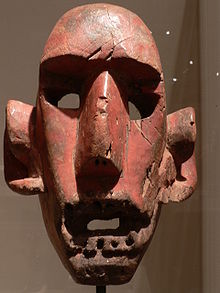
Ritual and ceremonial masks are a vital characteristic of the normal tradition of the peoples of part of Sub-Saharan Africa, e.g. roughly between the Sahara and the Kalahari Desert. Whereas the particular implications related to ritual masks extensively differ in several cultures, some traits are widespread to most African cultures. As an example, masks often have a non secular and non secular that means and they're utilized in ritual dances and social and non secular occasions, and a particular standing is attributed to the artists that create masks to those who put on them in ceremonies. Generally, mask-making is an artwork that's handed on from father to son, together with the information of the symbolic meanings conveyed by such masks. African masks are available all totally different colours, equivalent to pink, black, orange, and brown.

African international locations the place masks are used historically

Masks are one of many components of nice African artwork which have most evidently influenced Europe and Western art on the whole; within the 20th century, creative actions equivalent to cubism, fauvism and expressionism have typically taken inspiration from the huge and numerous heritage of African masks. Influences of this heritage can be present in different traditions equivalent to South- and Central American masked Carnival parades.


A masks utilized in ngil magic ceremonies of the Fang people of Gabon. Ethnological Museum of Berlin

In most conventional African cultures, the one who wears a ritual masks conceptually loses his or her human id and turns into the spirit represented by the masks itself. This transformation of the masks wearer right into a spirit often depends on different practices, equivalent to particular forms of music and dance, or ritual costumes that contribute to hide the mask-wearer's human id. The masks wearer thus turns into a form of medium that permits for a dialogue between the neighborhood and the spirits (often those of the dead or nature-related spirits). Masked dances are part of most conventional African ceremonies associated to weddings, funerals, initiation rites, and so forth. A few of the most advanced rituals which were studied by students are present in Nigerian cultures equivalent to these of the Yoruba and Edo peoples, that bear some resemblances to the Western notion of theatre.


Since each masks has a selected non secular that means, most traditions comprise a number of totally different conventional masks. The standard faith of the Dogon people of Mali, for instance, contains three primary cults (the Awa or cult of the lifeless, the Bini or cult of the communication with the spirits, and the Lebe or cult of nature); every of those has its pantheon of spirits, akin to 78 various kinds of masks general. It's typically the case that the creative high quality and complexity of a masks displays the relative significance of the portrayed spirit within the methods of beliefs of a specific individuals; for instance, less complicated masks such because the kple kple of the Baoulé individuals of Côte d'Ivoire (primarily a circle with minimal eyes, mouth and horns) are related to minor spirits.